Asteroid Terrestrial-impact Last Alert System Project
A project to patrol the entire night sky
every night in search of incoming asteroids
(and other interesting astronomical events!)
ATLAS is a small project with an ambitious goal: early warning of asteroid impacts on Earth.
Our goal is to provide a useful degree of warning for most impacts, meaning one day for a 30-kiloton "town killer," a week for a 5-megaton "city killer," and three weeks for a 100-megaton "county killer." (Yes, these are the same kilotons and megatons of TNT used to describe nuclear explosions because a serious asteroid impact is very similar to a nuclear explosion, including a mushroom cloud, but without radioactivity or fallout.) We intend to build and operate the system by the end of 2015 with $5M provided by the NASA Near Earth Objects Observations program ($3.5M construction and $0.75M per year for operations).
Here we describe the ATLAS Project, tell you why people think that asteroids can be dangerous to your health, discuss several historical impacts to Earth, and list other projects and efforts underway to reduce the risk of Earth being whacked by an incoming surprise.
Latest News - 2013 March 30
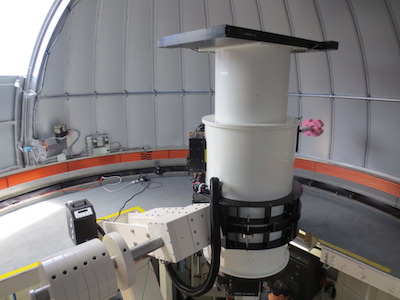
ATLAS Principal Investigator Dr. John Tonry and a correctly sized image of one of the telescope designs.
Progress on ATLAS is ramping up just three months into funding from NASA's Near Earth Object Observations program.
TELESCOPE: The team recently sent out a Request for Information (RFI) to solicit ideas from telescope manufacturers on how best to achieve ATLAS' ambitious survey goals. We received about a dozen innovative responses, possibly helped by the public interest in the Chelyabinsk meteor and damage.
Building on these responses, yesterday (March 29) we sent out a Request for Proposals (RFP), which describes the telescope specifications required by ATLAS. We hope within a month to have several proposals for consideration and to make a decision soon after.
When a decision on the telescope is made, the design of the camera, mount, and observatory will fall into place and we hope to report on those developments in our next update. The team expects construction to begin in mid-May with the goal of surveying the night sky for incoming asteroids by 2015.
PERSONNEL: In January we advertised for senior and junior software engineers, and for a post-doc (a PhD graduate). Larry Denneau has accepted the senior software engineer position and is already working on ATLAS with a view to ramping up to full-time within a few months; we can't imagine a more valuable addition to the team. Larry has more than 25 years of experience, which includes developing and managing the Pan-STARRS Moving Object Processing System for the past 8 years. Applications for the junior engineer and post-doc positions close tomorrow (March 31); we expect to make offers in early April.
LOCATION: We are still evaluating different locations for the telescopes. ATLAS does not require a superb "seeing" site; we care more about dark and clear sky. We also look at cost, Internet access, power, wind patterns, cloudiness, precipitation, and permitting. The best site may not always be the most obvious.
OTHER DEVELOPMENTS: Finally, in the "not exciting but very important" category, we are developing our operations and software flowcharts. These ensure that everyone working on the project stays on track with how to move forward with questions such as:
- How does the data get from the telescope to the computers at the observatory?
- How does the data get to the base facility at the Institute for Astronomy in Honolulu, and finally reported to international clearing houses like the Minor Planet Center in Boston?
- How do raw images get processed so that we can identify and precisely measure the location and brightness of asteroids and stars in the field?
Planning these details upfront will save time, energy and discussion as ATLAS moves forward.
Thank you for your interest in the ATLAS project.
Check out the ATLAS news archive.
Motivation
ATLAS scientists have all worked on the University of Hawai'i Pan-STARRS project, a system designed to find near-Earth objects (NEOs) moving through the Solar System long before they might strike us. Although Pan-STARRS can give us plenty of warning for large asteroids, it is not efficient at finding small asteroids that are on course to impact Earth. Pan-STARRS searches "deep but narrow" sections of space and takes months to patrol the whole sky.
ATLAS is designed to complement Pan-STARRS by monitoring "shallow but wide" sections of space. By removing the need to look all the way across the Solar System, as Pan-STARRS does, we can canvas the sky much more frequently. Even a small asteroid will become very bright when it makes its final approach to Earth; and ATLAS will be searching for these every night, weather permitting.
ATLAS will not provide enough warning time to deflect the asteroid – the intention is to warn of an impending impact. Once ATLAS detects a dangerous object it will immediately alert hundreds of professional and amateur astronomers whose combined observations will predict the impact with great precision, as was the case with the asteroid impact over Sudan in 2008.
The warning time depends on the size of the asteroid and how far away it is when first spotted. Our aim is to provide Civil Defense with a one-week warning for a large explosion (several megatons) and three weeks warning for a giant explosion (100 megatons).
The trick to spotting an asteroid before it hits Earth is to look everywhere possible in the sky. Unfortunately, a large portion of the sky toward the sun – about one quarter of the night sky – is impossible to look into from the ground without seeing daylight glare and losing sensitivity. Also, parts of the southern sky are not visible from the northern hemisphere since they are below the horizon (about one quarter of the southern sky cannot be seen from Hawai'i). This leaves half of the entire sky that in principle can be seen over the course of a night from a single mid-northern latitude site.
ATLAS is designed to cover that entire area at least twice each night, a strategy that will almost certainly detect any dangerous incoming asteroid visible in the night sky. We may also find one so small that it can only be detected on the last night before it plunges to Earth. This corresponds to a relatively harmless asteroid of a size that probably would not survive passage through the atmosphere.
Technique
We could survey the entire sky with a household digital camera, but its sensitivity would not be enough to spot an asteroid in time to take action. We can survey portions of the sky to high sensitivity – which is what Pan-STARRS and other NEO surveys are doing – but the coverage is patchy enough that objects can sometimes streak by when the system is looking elsewhere.
Instead, ATLAS will use an array of small telescopes (10-inch to 20-inch diameter) each with its own specially-designed CCD camera housed at one or two locations in Hawai'i to scan the entire visible dark sky twice a night. Having built some of the world's most advanced cameras for Pan-STARRS, we are confident in our team's expertise to build the ATLAS system. Currently in the design phase, we want to ensure that ATLAS can detect the smallest bang for the buck.
We can also write software that will automatically sift 500 megabytes of data per minute in real time to discover everything that has changed or moved since the last time we looked.
One small advantage to having two sites is being able to triangulate the 3D position of an asteroid that is within a week of impact and calculate whether it is a cause for worry. However, the advantage of two geographically separate sites over one site is not as great as one might think; since the Earth spins and orbits the Sun, the moving positions of a single telescope site and the incoming asteroid go a long way toward providing enough parallax to solve the same problem.
ATLAS will report all detections of asteroids and comets in real time to the Minor Planet Center. Any threatening event will immediately trigger professionals and amateurs around the world to collect data on any dangerous object. The observations from ATLAS combined with those from other sites will either eliminate the possibility of an impact or enable us to accurately predict the moment and place of impact.
The warning time that ATLAS will give us (see figure left) depends on the direction the asteroid is coming from. The system typically will give us a week's warning for a 50-meter (160-foot, few-megaton) asteroid and three weeks for a larger 140-meter (500-foot, 1,000-megaton) asteroid.
ATLAS is designed to detect objects to magnitude 20, which is astronomer-speak for "respectably, but not extremely faint." Imagine a match flame in New York viewed from San Francisco. The figure (left) shows an early estimate of the survey efficiency (which may be a little optimistic). In general, ATLAS will detect most objects bigger than 50-meter diameter that are coming toward the Earth in the night sky, but the probability levels off around 60 percent due to 40 percent of the sky being in daylight, and also because of the southern blind spot.
One way to address this is by building an ATLAS network: Deploying units in Hawai'i and California and Arizona would help mitigate blind spots from weather. Distributing units in longitude would enable us to view the night sky 24/7. And, since the ATLAS system is extremely modular, it would be easy to deploy in Australia or Chile or South Africa and close the southern hole through which asteroids can approach unseen.
Using our experience from building Pan-STARRS and other projects, we believe the ATLAS system is straightforward and achievable. Where possible we want to buy equipment such as telescopes, mounts, enclosures, and other materials; we want to recycle camera designs and software; and we want to use CCD detectors that we already have available.
We also want this system to operate robotically, requiring only light human oversight to make sure that everything is working properly. It is also important to ensure that each unit has enough local computer power to operate independently but has enough Internet connectivity that we can network many units together. We consider the initial ATLAS system to be a proof of concept and hope to geographically expand the system once we prove that it is an effective and cost-effective asteroid detection system.
Other Cool Stuff
There's a lot of cool stuff that ATLAS can do besides searching for killer asteroids.
- Look for denizens of the outer Solar System, such as dwarf planets like Pluto or Eris or a Nemesis star.
- Detect gravitational lensing when nearby stars pass in front of distant ones.
- Collect light curves of almost all of the variable stars in our Galaxy.
- Detect thousands of Type Ia supernova explosions to a redshift of 0.1 within the visible sky.
- See the flashes of light when a star is gobbled up by a super-massive black hole in a distant galaxy.
- Nightly monitoring of the activity of 100,000 active galactic nuclei caused by black holes at the centers of galaxies.
Click here to learn more about Other Cool Science that we will do with ATLAS.
Technical details about ATLAS can be found at astro-ph 1011.1028.

![[An early ATLAS design concept. Image credit: John Tonry, University of Hawaii Institute for Astronomy.]](/media/dpsi-quad2.jpg)
![[An alternate ATLAS design that has 3x the collecting area and 3x the field of view. Image credit: John Tonry, University of Hawaii Institute for Astronomy.]](/media/vt98a+ucam4.jpg)
![[Graph showing distribution of warning times. Image credit: John Tonry, University of Hawaii Institute for Astronomy.]](/media/warning_times.png)
![[Graph showing detection chances for a given impactor size. Image credit: John Tonry, University of Hawaii Institute for Astronomy.]](/media/impactor_detection.png)